You can make your own Pony Movie here: The Pony Mixer.
Friday, March 15, 2013


Wednesday, March 13, 2013
Social Cognition and Animals
My next few posts will share some videos that pertain to non-human animal sentience, cognition, and learning. Though these videos are not specifically about dogs, I think you can appreciate them for the insights they offer into various species of "Others."
The forces of anthropocentrism generally push people's conversations about non-human lives into a lumped category, where "animals" are collectively cast into a framework of understanding that is solely based upon comparisons with human beings. Identifying each species without down-casting comparisons, and acknowledging each individual within a given species as a distinct "someone," affords a deeper understanding of each creature--human and non-human--as important whole parts of the collective "we"--all living beings.
"What do we mean typically for cognition? The process or set of processes by which an organism acquires knowledge or awareness of events, of the relationship between them, of the context, of new situations and uses the data collected to understand, learning to learn and solve problems. In this video we can see the bachelors horse band of Learning Horse Farm, Education & Research Center in the Netherlands, during the first approach in preparation for saddling of the younger named Sparta, in a social learning context. The human animal, Francesco De Giorgio, moves in the bachelor's dynamics without influence it. Sparta learns new sensations on the back, without linear, mechanicistic and conditioning pattern. He isn't isolated from the others, as it usually happens in the equestrian world, but rather social cognitively learned from his father and his uncles. Also notice the calmness of the horses despite the dynamics of the bachelor's game and how the horses break the dynamic to prevent that the interaction becomes too reactive. They stay in a conscious, cognitive inner state, making them well aware of the human presence that they take in account in their movements. Horses have a well-defined cognitive-social instinct, with a very well developed capacity of how to interact with other horses, and human. There behaviour becomes reactive in contact with the anthropocentric activities/training conditioning methods the human world is used to. We humans can and we must preserve the cognitive and social heritage of horses. More info on www.equinezooanthropology.com and on www.thecognitivehorse.com"
Monday, March 4, 2013
Wednesday, February 27, 2013
The Good News :) ... And the Terribly Sad News :(
Okay, so, first the good news:
Tiger Lily has made a full recovery, and is doing GREAT!
All of her sores have healed, she has gained lots of weight, and she seems no worse for wear and tear. I'd never seen a sicker dog, ever, so it is really amazing that she pulled through. Thanks to everyone who was rooting for her--especially Dr. Lynn!--supplier of IV fluids, medicines, and TONS of bandages; and what a great suggestion, to use honey wraps to debride her injuries! I don't have a photo handy, but I'll find one and edit this post so you can see the difference.
And now, the sad, sad, really bad news: My horse, Fancy, had to be put down early Saturday AM, after an eight-hour fight to save her life in response to a bout of colic. She had a total bowel obstruction, was in a ton of pain, and began to bloat and develop toxemia. My vet gently informed me there was nothing else to be done, so while I petted her and told her goodbye, the vet administered a lethal injection of barbiturates. This is similar to putting a dog to sleep, but--and I wasn't expecting this--a lot more (horrifyingly) dramatic. I take comfort in the knowledge she is not in pain now, and that, though her life was cut short (she was 12, and the average horse life expectancy is more like 25-30,) she had a great life enjoying her pasture and hanging with her best friend, my daughter's horse, Phoenix. I've had Fancy since she was a yearling; Monica and Stephanie (with Dave's help) bought her for me as the BEST CHRISTMAS PRESENT EVER!
I had really looked forward to bringing her home to our new property one of these days, but such is life. Here is a video of Fancy in happier days, with her sister, Phoenix. They were both really muddy (evidence of a good horse life full of fresh air and freedom :) from playing outside at the farm in Marseilles, where I've been boarding them. Also, you won't be able to help noticing me speaking my version of horse baby-talk to them. Yeah, I do that ;)
And now, the sad, sad, really bad news: My horse, Fancy, had to be put down early Saturday AM, after an eight-hour fight to save her life in response to a bout of colic. She had a total bowel obstruction, was in a ton of pain, and began to bloat and develop toxemia. My vet gently informed me there was nothing else to be done, so while I petted her and told her goodbye, the vet administered a lethal injection of barbiturates. This is similar to putting a dog to sleep, but--and I wasn't expecting this--a lot more (horrifyingly) dramatic. I take comfort in the knowledge she is not in pain now, and that, though her life was cut short (she was 12, and the average horse life expectancy is more like 25-30,) she had a great life enjoying her pasture and hanging with her best friend, my daughter's horse, Phoenix. I've had Fancy since she was a yearling; Monica and Stephanie (with Dave's help) bought her for me as the BEST CHRISTMAS PRESENT EVER!
I had really looked forward to bringing her home to our new property one of these days, but such is life. Here is a video of Fancy in happier days, with her sister, Phoenix. They were both really muddy (evidence of a good horse life full of fresh air and freedom :) from playing outside at the farm in Marseilles, where I've been boarding them. Also, you won't be able to help noticing me speaking my version of horse baby-talk to them. Yeah, I do that ;)
Sunday, January 20, 2013
Monday, November 26, 2012
The Private Life of Love and Death
My dog,
Princess Tiger Lily, a boxer, is presently fighting for her life. She is lying
in my bed on a pile of towels, blankets, and layers of absorbent plastic-backed
pads. Her head is on Dave’s pillow, and she is presently sleeping, breathing
hard and fast, probably due to her high fever. She has cellulitis—a deep tissue
infection, in her upper thigh. This has caused a number of eruptive lesions,
from which vile, putrid drainage has been coursing. She is on two antibiotics,
pain medication, and a stomach medication. She has been getting hot baths in order
to soak her in wounds in Epsom salt-laden water, to help them drain. She has
lost a lot of weight, and had none to spare in the first place.
I have spent
the last three days literally tending to her around the clock, with Dave’s help.
I carry her outdoors, and she is such a good girl, despite feeling awful, and
cold, and weak—she eliminates outside. I then pick her up and carry her in for
her soak, which helps offset the chill. We then do some disgusting postural
draining, and then change all of her bedding and clean and dry her wounds. We
give her water in bed, and then feed her a serving of boiled rice and ground
beef. I wrap her wounds loosely, cover her with a blanket, pet, cuddle and
encourage her, and tell her how sorry I am she is feeling so bad. I remind her she is a strong “working
dog” breed, and she is brave and courageous. She is a boxer, a fighter—a 14
rounder. I remind her we have all sorts of things we've still not done together.
I tell her I love her, and lay my head against hers. She looks at me with big,
sad eyes. Sometimes she offers me her paw, and today she wagged her little stub
(docking is evil!) of a tail. Tomorrow Lynn, the vet, is paying a house call to
help clean and debride her wounds (gross.) I am hopeful she may pull through this, but
her history of health troubles and her challenges with maintaining her weight are concerning. Lily is a young-ish dog, and I hope we get more time together.
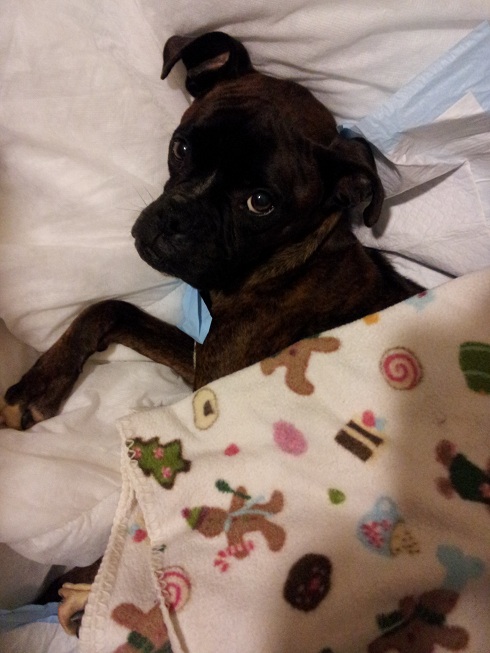
This
all reminds me of Nefer's downhill decline, last year, and her eventual—though not
untimely, considering she broke the record for Pharaoh hound life expectancy—death.
Nefer's death was not a highly publicized event outside of my immediate family.
I've been thinking about the stories I share—and those I do not share—with my
students. This has come up in reaction to comments made just this week by a past,
somewhat challenging, client of mine who is presently working with my daughter,
as a house sitter/ dog trainer. Apparently while still attending my classes, this
man asked me “how’s Nefer?” to which I purportedly replied “dead.” I did not
elaborate, or share any emotion, or publicly perform my grief, and I guess this
didn’t set well with him. He has mentioned my “coldness” and “lack of emotion”
to my embarrassed daughter more than once, shaking his head with disgust that I
could be “so insensitive and uncaring” regarding the loss of my pet.
During
this time of tending to Lily, I've mulled a bit on this man’s opinion regarding
my failure to share a proper performance of a very private grief, and it comes
around to that very point. My grief is private, not a flag to wave, and the death
of my dog was a huge and profoundly personal loss. It isn't for display, or for
good advertising. I will say this: her death came tenderly, with her head in my
arms, and she died at home, helped out of this world by my caring veterinarian
friend, Lynn. Tomorrow Lynn will come again, to help me with another struggle, this
time in efforts to save Lily’s life. I really hope I can share a joyful
announcement, in a few days time, that Lily is on the healing side of her
battle.
As I am
writing/ venting about all of this, I am wondering: will my writing about my
desire to have my privacy respected, and to have the benefit of the doubt if I
choose not to share deeply, make you hesitate to ask me how Lily is doing? I
hope not; if you happen to read this and
then see me some time after, please do ask. I am not unwilling to share what is
going on in my life, with my pets, to the level I am comfortable. If she
survives, the grueling nature of our struggle will be worth talking about—probably
way more than you want to hear--for having resolved happily. If, on the other
hand, Lily does die—though I desperately hope she doesn't—and if I seem terse
speaking of it, please understand the depth of my sadness is something I’ll again
keep private. I appreciate empathy, care, and commiseration, and believe the
sharing of personal stories regarding love, life, and even loss can be healing.
However some things are very private, and some loss transcends simple
explanation, in passing, to casually interested persons. Nefer's life was
bigger than this little story, as is Lily's.

Sunday, October 14, 2012
No Classes Today!
Just a quick reminder, for those who've not checked my news and alerts page:
There are no classes today, Oct. 14, 2012.
See you next week!
There are no classes today, Oct. 14, 2012.
See you next week!
Subscribe to:
Posts (Atom)